
2026-03-05 R43ples
La Novitade
Section titled “La Novitade”OC Meta
Section titled “OC Meta”- Numero di quadruple nella provenance corretta: 8,451,129,250. Numero di quadruple nella provenance originale: 7,976,167,041. Buon segno. Paradossalmente, però, la provenanza nuova pesa meno, forse per una differenza nell’algoritmo di compressione o per assenza di spazi o per informazioni duplicate e cancellate. 40.73 GB vs 36.48 GB
- Qlever ha indicizzato tutta la provenance in quattro ore e mezza come quadruple. ~172GB
refactor(migration): generalize provenance_to_nquads to handle all RDF data
Rename script to rdf_to_nquads and add --mode parameter to select which ZIP files to process: 'all' (default), 'data' (entity files only), or 'prov' (provenance se.zip files only).

feat: add HTTP method selection with GET default for read queries [release]
Aggiungere il GET a sparqlite mi è servito per generare un sottoinsieme di Index direttamente dall’endpoint pubblico, dato che tale endpoint accetta soltanto GET e non POST. Il sottoinsieme mi è servito per aggiungere dei test specifici per l’API di Index al repository oc_api
feat(migration): add predicate discovery, graph-less and non-recursive modes to extract_subset
Bump sparqlite to 1.2.0 and add unit tests.
test: set up test infrastructure for API query
test(index): add index API tests with real citation data
Citations from DOI 10.1162/qss_a_00292 (OpenCitations Meta paper).
fix(index): split UNION in venue OPTIONAL to fix Virtuoso SPARQL evaluation bug
Virtuoso incorrectly evaluates subsequent OPTIONAL blocks when a preceding OPTIONAL contains a UNION with a transitive property path (frbr:partOf+) that produces no matches. This caused empty author and source metadata for non-JournalArticle entities (e.g. fabio:Expression), leading to wrong author_sc and journal_sc values in citation results.
Splitting the single OPTIONAL with UNION into two separate OPTIONALs sharing the same ?venue variable is semantically equivalent and avoids the bug.
Also adds integration tests for author self-citation, journal self-citation, negative timespan, and month/day precision in timespan calculations, with real data from OpenCitations.
Quando un’entità non è un fabio:JournalArticle e non ha frbr:partOf, nessun ramo del UNION matcha. In teoria l’OPTIONAL dovrebbe semplicemente non produrre risultati e passare oltre. Invece Virtuoso, quando incontra un UNION con un property path transitivo (frbr:partOf+) che non matcha, “rompe” gli OPTIONAL successivi, facendoli restituire stringhe vuote. Quindi, per esempio, ci saranno sicuramente delle citazioni per cui author self citation risulta false quando dovrebbe essere true.
refactor(index): remove dead code and replace dateutil.parser with strptime
Remove unreachable code paths (encode, isinstance else branches, multi=False, reverse=False, defensive key checks) and replace dateutil.parser.parse with datetime.strptime using date padding. Add mock tests for SPARQL endpoint failures to reach 100% coverage.
fix(index): align v1 SPARQL queries with v2 and add v1 tests
The v1 __get_omid_of used plain literals only, failing to resolve DOIs stored as typed literals (^^xsd:string). The __br_meta_metadata had a UNION inside OPTIONAL that triggered a Virtuoso evaluation bug, corrupting GROUP_CONCAT results for authors. Both issues caused inconsistent author_sc values between v1 and v2 for the same citations.
Port the typed literal UNION and the split OPTIONAL fixes from v2. Replace bare except clauses with except RequestException and return ({}, []) instead of (None, None) from __br_meta_metadata to resolve pyright errors. Add dedicated v1 test file, rename v2 tests, extract shared helpers into conftest, and exclude ramose.py from coverage.
Aldrovandi
Section titled “Aldrovandi”feat(zenodo): generate methods description from knowledge graph
feat(zenodo): add funding metadata to generated configs
https://sandbox.zenodo.org/records/449574 https://sandbox.zenodo.org/records/449576 https://sandbox.zenodo.org/records/449570 https://sandbox.zenodo.org/records/449572
feat(zenodo): generate table for DMP
| Numero su DMP | Caso di studio | Autore/i | Tipo | Titolo | Data pubblicazione | DOI | URL | Repository | Licenza | Note |
|---|---|---|---|---|---|---|---|---|---|---|
| Aldrovandi | Bordignon, Alice [orcid:0009-0008-3556-0493]; Bonifazi, Federica [orcid:0009-0000-8466-5541]; Massari, Arcangelo [orcid:0000-0002-8420-0696]; Moretti, Arianna [orcid:0000-0001-5486-7070]; Barzaghi, Sebastian [orcid:0000-0002-0799-1527] | Dataset | Carta nautica - Digital Cultural Heritage Object - Aldrovandi Digital Twin | 2026-02-28 | https://sandbox.zenodo.org/records/466512 | Zenodo | cc0-1.0 (Metadata license); cc0-1.0 (Content license) | |||
| Aldrovandi | Bordignon, Alice [orcid:0009-0008-3556-0493]; Bonifazi, Federica [orcid:0009-0000-8466-5541]; Massari, Arcangelo [orcid:0000-0002-8420-0696]; Moretti, Arianna [orcid:0000-0001-5486-7070]; Barzaghi, Sebastian [orcid:0000-0002-0799-1527] | Dataset | Carta nautica - Optimized Digital Cultural Heritage Object - Aldrovandi Digital Twin | 2026-02-28 | https://sandbox.zenodo.org/records/466514 | Zenodo | cc0-1.0 (Metadata license); cc0-1.0 (Content license) | |||
| Aldrovandi | Bonifazi, Federica [orcid:0009-0000-8466-5541]; Massari, Arcangelo [orcid:0000-0002-8420-0696]; Moretti, Arianna [orcid:0000-0001-5486-7070]; Barzaghi, Sebastian [orcid:0000-0002-0799-1527] | Dataset | Carta nautica - Raw - Aldrovandi Digital Twin | 2026-02-28 | https://sandbox.zenodo.org/records/466516 | Zenodo | cc0-1.0 (Metadata license) | |||
| Aldrovandi | Bonifazi, Federica [orcid:0009-0000-8466-5541]; Massari, Arcangelo [orcid:0000-0002-8420-0696]; Moretti, Arianna [orcid:0000-0001-5486-7070]; Barzaghi, Sebastian [orcid:0000-0002-0799-1527] | Dataset | Carta nautica - Processed raw model - Aldrovandi Digital Twin | 2026-02-28 | https://sandbox.zenodo.org/records/466518 | Zenodo | cc0-1.0 (Metadata license) |
Time Agnostic Library
Section titled “Time Agnostic Library”Temporal SPARQL extensions require either native support in triplestores or an external processing layer that translates extended queries into operations executable on standard endpoints. Since no temporal SPARQL extension has been adopted by mainstream triplestores or standardized by the W3C, the former path remains unavailable, and the latter results in the same architectural pattern as a library operating directly on standard SPARQL, with the addition of a non-standard query syntax. The approach presented here avoids this intermediate layer: users write standard SPARQL queries, and the library handles temporal reconstruction transparently, ensuring compatibility with any compliant triplestore.
feat(benchmark): add R43ples benchmark scripts and analysis integration
Cose belle: https://ctan.mirror.garr.it/mirrors/ctan/macros/latex/contrib/algorithm2e/doc/algorithm2e.pdf
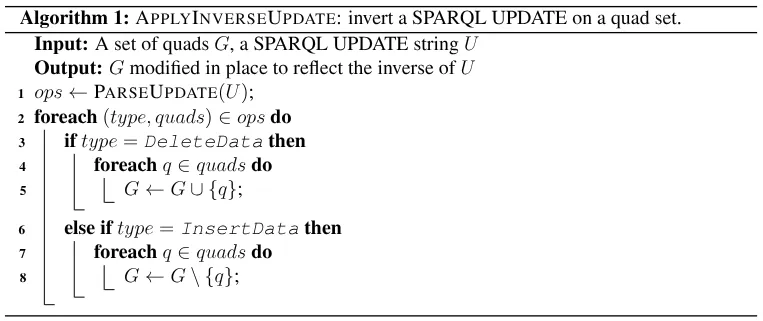
feat!: replace DeltaQuery modified dict with net delta quad sets
DeltaQuery.run_agnostic_query() now returns additions and deletions as sets of N3-encoded quad tuples instead of raw SPARQL UPDATE strings keyed by timestamp. Add AgnosticEntity.get_delta() for computing net deltas directly on a single entity without SPARQL query overhead.
BREAKING CHANGE: DeltaQuery output replaces "modified" dict with "additions" and "deletions" sets of quad tuples.
Domande
Section titled “Domande”- Ho scoperto che YAGO (ovvero Wikidata con entità human-readable) ha un timeout di 1 minuto sulle query sia SPARQL che API. Lo dicono qui: https://yago-knowledge.org/sparql. Usano Blazegraph. Lo so perché c´è una cartella blazegraph sul loro repo: https://github.com/yago-naga/yago-website. Idea per un articolo: confronto su come servizi su dataset RDF di grandi dimensioni in giro per il mondo gestiscono il problema della scalabilità vs come facciamo noi.
- Per la tabella con i record del DMP per i vari casi studio dello Spoke 4 io faccio continuare la numerazione dall’ultima riga già presente oppure lascio vuoto e ci pensiamo dopo?
- Inoltre nella colonna licenza metto entrambe le licenze? CC0 sempre per i metadati più eventualmente quella dei dati
- Mario mi confermi che per le API di Index e Meta utilizziamo sempre e solo il fork locale di Ramose e mai la libreria? Mi ripeti il motivo di questa cosa? Perché adesso devo lavorare su Ramose e non vorrei che per l’API rimanesse il fork.
  # ramose 1.0.8  self.preprocess(par_dict, self.i, self.addon)  query = self.i["sparql"]  for param in par_dict:      query = query.replace("[[%s]]" % param, str(par_dict[param]))
  # fork  self.preprocess(par_dict, self.i, self.addon)  # Gestione parametri lista  par_dict = {p_k: [par_dict[p_k]] if not isinstance(par_dict[p_k], list) else par_dict[p_k] for p_k in par_dict}  combinations = product(*par_dict.values())  parameters_comb = []  for combination in combinations:      parameters_comb.append(dict(zip(list(par_dict.keys()), list(combination))))  list_of_res = []  for par_dict in parameters_comb:      query = self.i["sparql"]      for param in par_dict:          query = query.replace("[[%s]]" % param, str(par_dict[param]))
Con il fork locale, quando un utente cerca per DOI un’entita’ che ha piu’ OMID associati (perche’ ad esempio ci sono duplicati nel database), RAMOSE esegue una query SPARQL separata per ciascun OMID e poi unisce i risultati. Il pacchetto installato non puo’ farlo perche’ non sa gestire il caso in cui il preprocessor restituisce più valori da iterare. In pratica: un DOI potrebbe risolvere a piu’ bibliographic resource distinte in OpenCitations Meta. Il fork permette di interrogare Index per ciascuna di esse e aggregare le citazioni.
- https://reuse.software/spec-3.3/ e https://www.linuxfoundation.org/licensebestpractices
- wl.py in oc-api è solo in oc-api o è condiviso tra vari servizi?
- Siamo consapevoli del fatto che la V1 di index fa una query diretta all’end point di Meta? Cioè proprio tramite query SPARQL a un servizio esterno.